MIPCOM 2026: microdramas take the main stage in Cannes
Vertical drama was the subject most people at MIPCOM 2026 wanted to talk about. Vertical Observer attended the market's vertical sessions in Cannes: this is what the panels said, which deals were signed around them, and how the claims on stage compare with the published data.
The event
- Event
- MIPCOM Cannes 2026
- Dates
- 12 to 15 October 2026
- Venue
- Palais des Festivals et des Congrès, Cannes
- Attended
- On press accreditation from MIPCOM, with thanks to the organisers
A vertical track at the biggest TV market
MIPCOM, the international television market held each October at the Palais des Festivals in Cannes, gave microdramas and vertical series a programme of their own for the first time in 2026. The organiser announced it in July: headline sessions on the main stage, an invitation-only Global Microdrama & Vertical Leaders' Summit, a new Vertical Content Speed Matchmaking category next to the scripted and unscripted ones, and crossovers into the market's creator and branded-content tracks.
The market as a whole was slightly smaller than a year earlier: 10,100 delegates from 104 countries and 3,150 buyers, against about 10,600 delegates and 3,300 buyers in 2025, on the organiser's closing figures reported by Media Play News. Vertical drama was the subject that filled rooms. Deadline reported that the leaders' summit on the Wednesday morning was packed, that buyers including ZDF, TVN and Kanal D took part in the vertical matchmaking session, and that the biggest vertical deal of the week came from TikTok, at MIPCOM for the first time.
At the closing press conference, MIPCOM's director Lucy Smith named vertical storytelling and microdramas among the forces challenging established formats, Media Play News reported.
This Week in Vertical
A free weekly email of every report published here that week, each with its basis and sources. No advertising. Past issues
PIVOT: why every entertainment company needs a vertical strategy
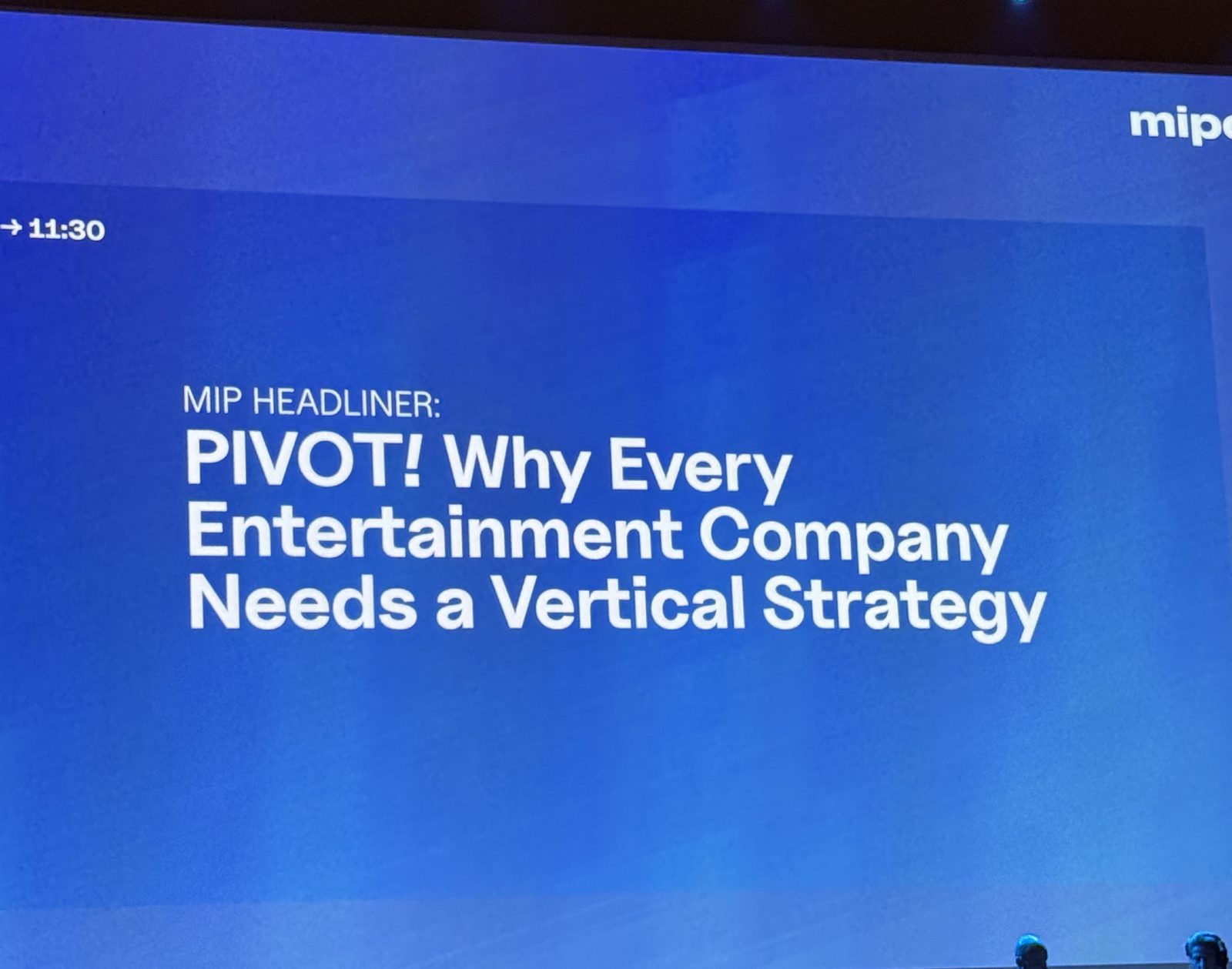
For anyone following the business, the centrepiece was the MIP Headliner on the morning of 14 October in the Grand Auditorium. Scott Roxborough, European bureau chief of The Hollywood Reporter, put three executives whose companies were built on vertical drama in front of an audience he described as largely from traditional television: Anatolii Kasianov, co-founder and co-CEO of Holywater Tech, which runs My Drama; Sammie Hao, head of talent and business development at Crazy Maple Studio, the operator of ReelShort; and Tanya Cohen, co-CEO of Made By Us Studios, a creator-led studio. Vertical Observer recorded the session, and the quotes below come from that recording.
Roxborough opened with the question many in the room were asking: why vertical drama is not "Quibi 2.0", a reference to Quibi, which raised $1.75bn and shut down in 2020, the year it launched. Kasianov pointed to the gap between low-cost social video and premium storytelling on the phone, and to a way of working that tests before it spends. "Low-cost production, being very efficient and data-driven, allows us to not just produce something for tens of millions of dollars and hope it works," he said. Holywater measures how a title's marketing performs and puts more budget behind what works.
Cohen said Quibi had the right device and the wrong engine, with famous names and big budgets but too little of the craft of storytelling. Vertical series, she said, are built on hooks that draw viewers in within seconds, a discipline she traced to creators on YouTube and TikTok: "They're movies. There's a beginning, middle, and end." Hao described a lasting change in viewing behaviour and an audience television had neglected: vertical drama "brought a lot of joy to the female audiences", a market Hao called underserved for a long time.
Who watches, and what a series costs
Holywater's own data have changed the picture of who watches. Kasianov said men made up 1% of its audience two years ago and about 30% now, after it began releasing more action and thrillers. That matches the report Holywater published with Owl & Co in July, which put the male share of My Drama's monthly users at 30.3%, up from 1.1%. Omdia's consumer research, presented in Cannes by María Rúa Aguete on 13 October, found men were 47% of microdrama users across the markets it surveyed and 54% in the UK (who watches microdramas).
Kasianov also cited a survey of Holywater's users that the company has not published. More than 70% of them, he said, also subscribe to a streaming service, and Netflix is the platform they most often ask to watch its titles on. His conclusion was that vertical drama competes with TikTok and YouTube Shorts for time and attention more than with the big streamers.
Hao gave the clearest numbers on production. A live-action series costs Crazy Maple "in a range of 200k to 300k" in production fees, before the company's own costs, and takes "about three to four months" from concept to final product. Data from each release feeds the next story, so shows that look alike carry plots built on what earlier ones taught the studio. The range sits at the top of the published budgets in our production costs guide, where company figures run from $100,000 to $250,000 and TheWrap reports most series at $150,000 to $300,000. Cohen described shoots built for speed, with time for one or two takes.
We don't look at vertical as a format. We look at vertical as the content.
AI: a tool, or most of the volume?
Roxborough called AI the elephant in the room, observing that AI-made titles have taken over much of China, the largest microdrama market. Kasianov said Holywater runs separate platforms for live action and for AI. Live action will stay, he argued, because audiences follow actors and IP holders need it, while AI "is really democratizing production" for filmmakers who lack a live-action budget.
Cohen called AI "obviously a tool" that needs "a human being behind the tool", and asked whether viewers will keep paying for AI-made series over time: views are one measure and engagement another. She put the cost gap at about twenty thousand for some AI series against two hundred thousand for live action. MIPCOM's daily news summed up her position as "the more artificial the world, the more authenticity we crave". Our guide to AI in microdramas sets out the published cost comparisons and the labelling rules that apply.
Legacy media moves in: Fox, Kevin Hart, WWE and TikTok
The deals around the market showed how established companies are entering. On 13 October Fox Entertainment signed a first-look deal with Kevin Hart's Hartbeat: 25 live-action vertical titles from Hartbeat's Codeblack, Essence and Revolt labels will premiere on a Codeblack-branded channel inside Holywater's My Drama app, and Fox will develop the strongest into film and television and distribute them worldwide (Fox and Hartbeat). Fox already holds a stake in Holywater. On stage, Kasianov said Hartbeat chose Holywater for its scale and its audience.
Hao used the panel to show a clip from a horizontal cut of ReelShort's project with WWE, the first time it had been shown outside the company. The vertical series, Agent of Shadows, premiered on ReelShort on 23 October (WWE and ReelShort). Wrestling and vertical drama "share the same DNA", Hao said, with larger-than-life characters and emotional cliffhangers: "We believe that good stories can transform from different formats."
By Deadline's account, the biggest vertical deal of the week came from TikTok: a multi-year co-production slate of creator-led micro-series with Made By Us Studios for TikTok and its drama app PineDrama, starting with Player, starring the creator Hannah Stocking, and The Knock. It was unveiled at a Creators Connect session on 14 October. Cohen, whose studio also signed an exclusive partnership with Dentsu Entertainment at Cannes Lions in June, told the PIVOT audience she expects a vertical series to win a Golden Globe and a vertical story to reach cinemas: "I think every legacy media company needs to be getting into vertical storytelling today."
Elsewhere, A+E Global Media brought nearly 200 Lifetime library titles to the market recut as vertical microseries (A+E). ReelShort told Prensario it was targeting telecom operators for bundles, and Orange agreed to carry ReelShort on its Max it TV service in 17 markets in Africa and the Middle East, C21 reported. Anthony E. Zuiker, creator of CSI, presented his AI true-crime platform Cinemalistics on the main stage on 13 October.
The numbers presented in Cannes
Several research firms used the market to present figures. They measure different things and should not be added together; the market size guide compares the published estimates by scope and measure.
Omdia's split leaves about $3.5bn of its 2026 total outside China, of which Forbes reports the United States at 44%. Kasianov's "more than four billion this year", which he attributed to media research, is close to the $4bn that Owl & Co, in its report with Holywater, gives for paid vertical drama outside China.
One figure travelled in two versions. On stage, and in MIPCOM's daily news, Dentsu's 62% was given as the share of Gen Z viewers who watch for an hour or more at a time; Dentsu's own report gives it for all microdrama viewers in its survey, with Gen Z the group most likely to watch for more than two hours.
Figures presented at MIPCOM 2026
| Figure | What it measures | Presented by | Reported in | Basis |
|---|---|---|---|---|
| $14.1bn, 75% from China | Global microdrama revenue, 2026 | María Rúa Aguete, Omdia, 13 October | Forbes | estimate |
| 47% men; 54% in the UK | Share of microdrama users in the markets Omdia surveyed | Omdia, 13 October | Omdia consumer research, April 2026 | estimate |
| One in five | Consumers who watch microdramas, 8,400 surveyed in 12 markets | Cathy Boxall, Dentsu, 12 October | Drop Media | estimate |
| 62% | Microdrama viewers whose typical session lasts longer than an hour | Dentsu; Cathy Boxall, 12 October | Dentsu, Entertainment Spotlight 2026 | estimate |
| About 30% | Men in Holywater's audience (30.3% of My Drama monthly users in its July report) | Anatolii Kasianov, Holywater, 14 October | Vertical Observer recording; Holywater and Owl & Co | company |
| 200k to 300k per series | Production fee for a live-action ReelShort series | Sammie Hao, Crazy Maple Studio, 14 October | Vertical Observer recording | company |
| 10,100 delegates; 3,150 buyers | MIPCOM 2026 attendance, from 104 countries | MIPCOM, 14 October | Media Play News | company |
Creators: the Power Brokers
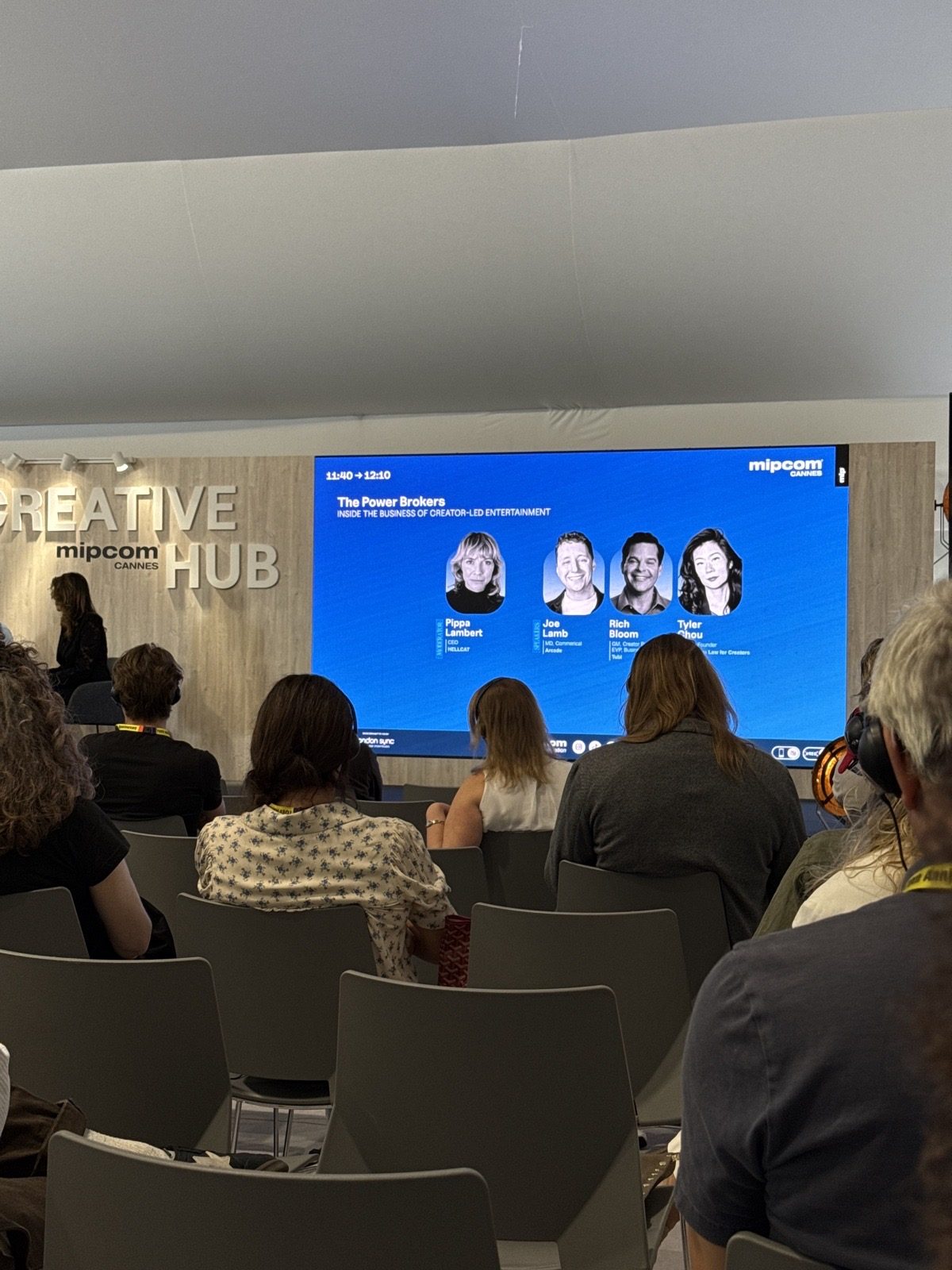
In the Creative Hub straight after PIVOT, "The Power Brokers" asked how platforms, studios and creator businesses now do deals. Pippa Lambert, founder of Hellcat, moderated Rich Bloom of Tubi, Tyler Chou of Tyler Chou Law for Creators and Joe Lamb of Arcade, the company behind the Sidemen. Vertical drama was not on the agenda, but the questions were the ones microdrama studios face too: who owns the IP, and who controls distribution. Vertical Observer recorded this session as well.
Bloom said Tubi has made more than 60 original exclusive titles with creators and leaves them in creative control by default: "Creators own the IP, and we get an exclusive window." Chou, who spent 20 years at studios and law firms before setting up a practice for creators, warned against depending on one platform: "YouTube is your landlord, and they can kick you off or raise the rent." Her advice to creators thinking of selling was to bring in operators and build more revenue streams first. Lamb described Arcade's enrolment in YouTube's partner sales programme, which lets it sell its creators' YouTube advertising to brands directly.
What we took away
Three things stood out from the week.
- The case made to traditional television has moved from the format to the economics: series made for a few hundred thousand dollars, tested within weeks and scaled when the data supports it.
- The audience is broader than the format's reputation. Holywater's male share and Omdia's survey both point away from the idea of a romance genre watched only by women.
- AI is the open question. The companies on stage agreed that it cuts costs, and none could yet show whether audiences pay for AI-made series in the same way over time.
Most figures quoted in Cannes came from the companies themselves or from research firms close to the market. Our microdrama statistics and the market data table date each published figure and label it by basis.
Vertical Observer attended MIPCOM Cannes 2026 on press accreditation from the organiser, RX France. Quotes from the PIVOT and Power Brokers sessions come from our own recordings; other quotes and figures are credited to the outlet that reported them.

Sources and further reading
- MIPCOM Cannes unveils microdrama and vertical content programme (press release, 20 July 2026) (opens in a new tab) MIPCOM
- Closing press release, 14 October 2026 (opens in a new tab) MIPCOM
- MIPCOM Day Three wrap-up, 14 October 2026 (opens in a new tab) MIPblog
- MIPCOM Day Two wrap-up, 13 October 2026 (opens in a new tab) MIPblog
- Vertical drama offers brands a new route to audiences (issue 2) (opens in a new tab) MIPCOM Daily News
- MIPCOM 2026 takeaways, 15 October 2026 (opens in a new tab) Deadline
- MIPCOM Cannes attendance dips as AI, creators and vertical dramas reshape global entertainment market, 14 October 2026 (opens in a new tab) Media Play News
- AI, vertical dramas take center stage at MIPCOM Cannes 2026, 14 October 2026 (opens in a new tab) Media Play News
- One in five consumers watching microdramas, dentsu study finds, 12 October 2026 (opens in a new tab) Drop Media
- MIPCOM Cannes 2026: who pays for entertainment now? (Maureen Kerr), 19 October 2026 (opens in a new tab) Forbes
- Fox Entertainment, Kevin Hart's Hartbeat sign vertical drama deal (Scott Roxborough), 13 October 2026 (opens in a new tab) The Hollywood Reporter
- TikTok and Made By Us micro-series slate (Jesse Whittock), 14 October 2026 (opens in a new tab) Deadline
- TikTok's second microdrama agreement, with Made By Us Studios (Katie Kilkenny), 14 October 2026 (opens in a new tab) The Hollywood Reporter
- ReelShort at MIPCOM 2026: telco bundles and branded microdramas, 15 October 2026 (opens in a new tab) Prensario
- Orange to distribute ReelShort microdramas across Africa and the Middle East (Ed Waller), 18 October 2026 (opens in a new tab) C21Media
- Anthony Zuiker launches Cinemalistics true-crime app (Jesse Whittock), 13 October 2026 (opens in a new tab) Deadline
- Holywater Tech and Owl & Co publish first industry report on the vertical series audience (opens in a new tab) Holywater
- Dentsu Entertainment and Made By Us Studios launch creator-led IP partnership, 23 June 2026 (opens in a new tab) Drop Media
- A+E Global Media and Lifetime microdrama slate, 8 October 2026 (opens in a new tab) Variety
- Entertainment Spotlight 2026, insight 3 of 10: most viewers watch microdramas for over an hour per session (opens in a new tab) Dentsu
Correction
: The table of figures gave Dentsu's 62% as the share of Gen Z microdrama viewers who watch for an hour or more per session, as MIPCOM's daily news reported it. Dentsu's own report gives 62% for all microdrama viewers in its survey; the row and the text now say so.
This Week in Vertical
A free weekly email of every report published here that week, each with its basis and sources. No advertising. Past issues